Before writing an entry, please check with us at editors[at]anthroencyclopedia.com to make sure the topic is not currently in production and to ensure you fulfil our author criteria. OEA authors should hold a PhD in Anthropology (or a very closely related discipline); they need to have demonstrated expertise of the anthropological literature on the topic in question; and they should have previously published in peer-reviewed journals (preferably on the topic in question). Even when you have received permission to author an entry, this does not mean that the entry will be accepted, as acceptance depends strictly on peer-review.
If you submit an entry to the OEA, you thereby agree to adhere to the following structural and stylistic and editorial guidelines.
Entry structure
The word count of first entry submissions must be around 5,000 words (excluding the bibliography but including footnotes). We can only review entry drafts that meet this target by a margin of +/- 600 words. Entries include:
Abstract (200-300 words) (Providing an abstract is essential for the review process)
- How do you define/understand the concept in question and why it is important/interesting for a broad audience (beyond anthropology)?
- What key insights have social and cultural anthropologists brought to understanding the concept?
- Clearly lay out the structure of the entry that follows.
Introduction
- Make clear in some depth why the concept is important to a general public.
- State clearly what you understands the concept to mean (initial definitions can be challenged and debated later on, in the main body).
- Mention how other academic disciplines/politicians/the media have understood the topic.
- End on the key insights anthropology has provided regarding the topic and how the entry will proceed. A good example for this structure is our entry on tax.
Main body
- divided into 3-4 subsections with short, descriptive titles
Conclusion
- conveys to a broad audience why studying the topic in question remains relevant and interesting in the future
Note on contributor of around 50 words
Contact details i.e. postal address, email address (and ORCID if possible)
Writing style
For successful OEA entries good writing style is as important as high quality content. OEA entries explain single concepts (such as 'colonialism', 'climate change', 'ethnicity' etc.) for academic readers as well as the general public. In order to cater to this broad audience, entries focus in tone and complexity on undergraduates with limited to no prior knowledge of social or cultural anthropology. To do so, the writing style must be as follows:
- Use simple language. This means avoiding jargon at all cost (technical terms are of course welcome but they always need to be explained when first used), using short sentences as much as possible, and minimising the use of brackets, footnotes and lists.
- Focus primarily on the main concepts themselves and the insights that anthropology has contributed to them, rather than the influence that these concepts may have had on anthropology as a discipline. Please assume that our audience does not care much about anthropology, but that it cares a lot about the concept in question.
- Illustrate each major theoretical point with a concrete ethnographic example from around the world. Concrete examples keep audiences engaged and play to the strength of our discipline.
- State at the beginning of each section what the section is about and how it fits into the entry's overall narrative.
- Introduce ideas directly and add their proponents as a reference afterwards, rather than presenting ideas by starting with whatever author is known for them.
- Be as balanced in tone as possible. Please do not put forward individual arguments but summarise the already established insights and debates from our discipline.
- Reference the major anthropological works pertaining to the topic in question as well as whatever recent work you need to cite; but please do not try to cite the whole field.
For examples of the writing style that we are after please see our entries on the anthropocene, games or tourism.
Editorial guidelines
Please find a full overview of our editorial guidelines (punctuation, referencing styles etc.) here: OEA editorial guidelines
Pictures
We are always happy to receive up to two pictures (including captions) for particular entries, provided they are necessary to further the argument. If you do provide pictures, please ensure that you hold written permission from the copyright owners for all people who may appear in them. All pictures should be provided in .jpg format, with a minimum resolution of 890x440px.
Submission
All manuscripts as well as all additional material should be sent to editors[at]anthroencyclopedia.com
Copyright: We can only accept original submissions that are not under review elsewhere. The copyright of all entries is held by their authors. Entries are licensed to the OEA under a Creative Commons Attribution-NonCommercial 4.0 International License. Thus, readers will be able to download, copy, share and adapt OEA material as long as they give appropriate credit, including the name of the authors and all other attribution parties. The license also means that the material authors provide may not be used by third parties for commercial purposes, i.e. for uses primarily intended for commercial advantage or monetary compensation. Manuscript submission and publication are free.
Review process
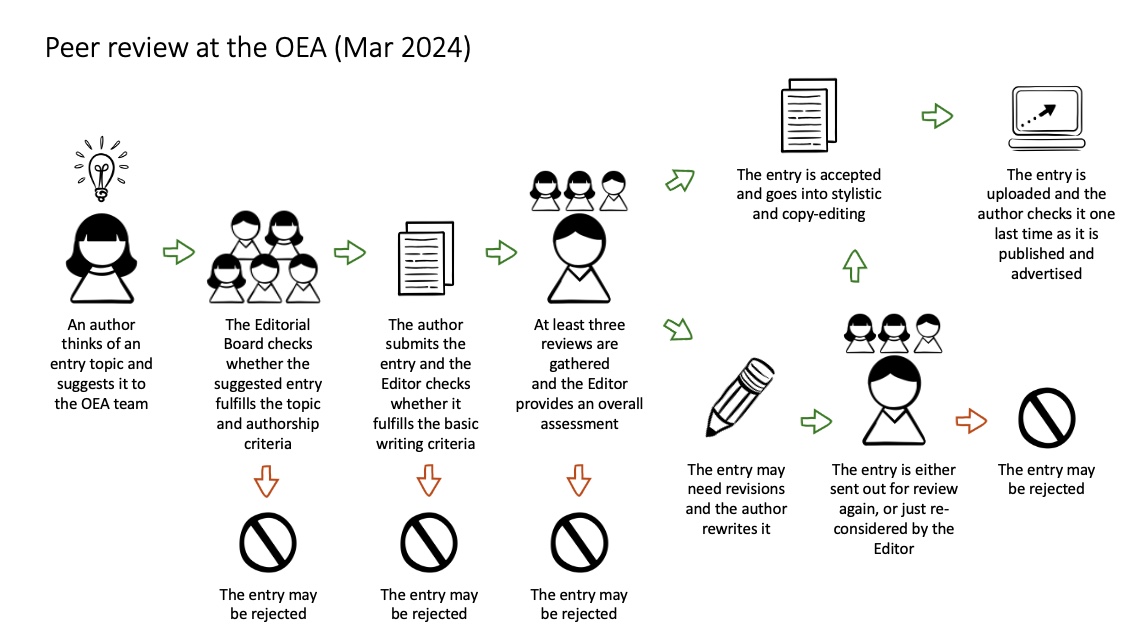
Members of our editorial board and external reviewers will review the abstract of each entry before either reviewing the entries themselves or sending them to specialists in the respective field. This is why receiving an abstract with each entry is so important. We aim to ensure that authors receive constructive feedback. Reviews are 'single blind' meaning that reviewers know who authors are but authors will not know their reviewers. This allows reviewers to disclose potential conflicts of interest.
While we cannot commit to fixed review times, we aim to provide authors with a first reply in less than 3 months of manuscript submission. Once a manuscript has been accepted we can copy-edit it and make it public in less than 3 weeks.